From Where Did Sherpas Ancestors Come? What Has Influenced Much of South Asias Arts?
| བོད་པ་ | |
|---|---|
 | |
| Total population | |
| c. 6.seven million | |
| Regions with significant populations | |
 China China | six.3 million[2] |
| Aksai Chin | 10,000[iii] |
 Bhutan Bhutan | 400,000[four] |
 India India | 182,685 (2011 demography)[5] |
 Nepal Nepal | twenty,000–40,000[vi] [4] |
 United States United States | 10,000[7] |
 Canada Canada | 8,040[8] |
 Switzerland Switzerland | iv,000[9] |
 Australia Australia | 1,000[10] |
 New Zealand New Zealand | 66 (2006)[eleven] |
 Nihon Nihon | lx (1998)[eleven] |
| Languages | |
| Tibetic languages and Chinese languages | |
| Organized religion | |
| Predominantly Tibetan Buddhism; significant minority of Bon; Christianity, Islam | |
| Related ethnic groups | |
| Sherpa· Qiang· Ngalop· Sharchop· Ladakhis· Baltis· Burig· Kachin· Yi· Bamar· Other Sino-Tibetan-speaking peoples | |
| Tibetan people | |||||||||||||||||||||||||
|---|---|---|---|---|---|---|---|---|---|---|---|---|---|---|---|---|---|---|---|---|---|---|---|---|---|
| Chinese name | |||||||||||||||||||||||||
| Chinese | 藏族 | ||||||||||||||||||||||||
| |||||||||||||||||||||||||
| Tibetan name | |||||||||||||||||||||||||
| Tibetan | བོད་པ་ | ||||||||||||||||||||||||
| |||||||||||||||||||||||||
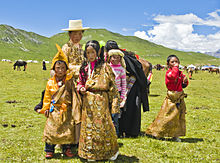
The Tibetan people (Tibetan: བོད་པ་, Wylie: bod pa, THL: bö pa; Chinese: 藏族) are an E Asian ethnic group native to Tibet. Their current population is estimated to be effectually 6.7 million. In addition to the majority living in Tibet Autonomous Region of China, significant numbers of Tibetans live in the Chinese provinces of Gansu, Qinghai, Sichuan and Yunnan, too as in India, Nepal and Kingdom of bhutan.
Tibetan languages belong to the Tibeto-Burman language group. The traditional or mythological, explanation of the Tibetan people'southward origin is that they are the descendants of the human Pha Trelgen Changchup Sempa and rock ogress Ma Drag Sinmo. Information technology is thought that most of the Tibeto-Burman speakers in Southwest China, including Tibetans, are direct descendants from the ancient Qiang people.[12]
Most Tibetans practise Tibetan Buddhism, although some observe the indigenous Bon religion and at that place is a small Muslim minority. Tibetan Buddhism influences Tibetan art, drama and architecture, while the harsh geography of Tibet has produced an adaptive culture of Tibetan medicine and cuisine.
Demographics [edit]
As of the 2014 Census, there are about six million Tibetans living in the Tibet Democratic Region and the 10 Tibetan autonomous prefectures in the provinces of Gansu, Qinghai, Yunnan and Sichuan.[13] [14] The SIL Ethnologue in 2009 documents an additional 189,000 Tibetic speakers living in India, 5,280 in Nepal and iv,800 in Bhutan.[15] The Central Tibetan Administration'southward (CTA) Dark-green Volume (of the Tibetan Authorities in Exile) counts 145,150 Tibetans outside Tibet: a little over 100,000 in Bharat; over 16,000 in Nepal; over 1,800 in Bhutan, and over 25,000 in other parts of the world. There are Tibetan communities in the United States,[sixteen] Commonwealth of australia, Brazil, Canada, Costa rica, French republic, Mexico, Norway, Mongolia, Germany, Switzerland and the United kingdom of great britain and northern ireland. In the Baltistan region of Northern Pakistan, the Balti people are a Muslim ethnicity of Tibetan descent numbering effectually 300,000.[17]
There is some dispute over the electric current and historical number of Tibetans. The Fundamental Tibetan Administration claims that the v.4 million number is a subtract from half dozen.three meg in 1959[18] while the Chinese authorities claims that information technology is an increase from 2.vii million in 1954.[19] However, the question depends on the definition and extent of "Tibet"; the region claimed by the CTA is more expansive and Cathay more diminutive. Also, the Tibetan administration did not take a formal demography of its territory in the 1950s; the numbers provided by the administration at the time were "based on informed guesswork".[20]
Mainland china officials attribute growth of the Tibetan population to the improved quality of health and lifestyle of the average Tibetan since the get-go of Chinese governance in Tibet. According to Chinese sources, the death rate of women in childbirth dropped from 5,000 per 100,000 in 1951 to 174.78 per 100,000 in 2010, the infant bloodshed rate dropped from 430 infant deaths per 1,000 in 1951 to 20.69 per one,000 by the yr of 2010 (baby mortality in China as a whole was officially rated at 14 per 1,000 in 2010).[21] The average life expectancy for Tibetans rose from 35.5 years in 1951 to over 67 years by the end of 2010.[22]
In China [edit]
According to the Sixth National Population Census of the People's Commonwealth of Cathay (2010), there are half-dozen,282,187 Tibetans nationwide:[23]
There are two,716,388 people in the Tibet Autonomous Region, ane,496,524 people in Sichuan Province, 1,375,059 people in Qinghai Province, 488,359 people in Gansu Province (mostly in Gannan Tibetan Autonomous Prefecture and Bairi Tibetan Democratic Canton) and 142,257 people in Yunnan Province (mostly in Diqing Tibetan Autonomous Prefecture). Tibetans business relationship for 0.47% of the total population of the country. Tibetans account for 90.48% of the total population in Tibet Region, 24.44% of the total population of Qinghai and ane.86% of the total population in Sichuan.
Of all Tibetans in Cathay, 315,622 people live in cities, 923,177 in towns, and 5,043,388 people (80.3%) live in rural areas.
In India [edit]
In Bharat Tibetic people are establish in the regions of Ladakh (Ladakhi and Balti), Spiti valley, Uttarakhand (Bhotiya), Sikkim (Bhutia), and Arunachal Pradesh (Khamba, Lhoba Delhi-Majnu ka tilla and Monpa people). There are also nearly 100,000 Tibetans living in exile in India since 1959.[24] The bulk of them living in Tibetan enclaves such every bit Dharamshala and Bylakuppe.
In Nepal [edit]
Tibetans are known as Bhotiyas in Nepal, where they are majority in regions such every bit Upper Mustang, Dolpo, Walung region and Limi valley. Nepal is also home to other Tibetic people such as the Sherpa and Thakali. There are also more than ten,000 Tibetan refugees in Nepal.[25]
Linguistic communication [edit]
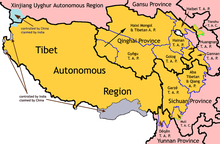
Areas in which concentrations of ethnic Tibetans live within China

Tibetan peddler living in Nepal
The Tibetic languages (Tibetan: བོད་སྐད།) are a cluster of mutually unintelligible Sino-Tibetan languages spoken past approximately viii million people, primarily Tibetan, living across a wide area of East and Southern asia, including the Tibetan Plateau and Baltistan, Ladakh, Nepal, Sikkim, and Bhutan. Classical Tibetan is a major regional literary language, especially for its use in Buddhist literature.
The Central Tibetan language (the dialects of Ü-Tsang, including Lhasa), Khams Tibetan, and Amdo Tibetan are more often than not considered to be dialects of a single linguistic communication, particularly since they all share the same literary linguistic communication, while Dzongkha, Sikkimese, Sherpa, and Ladakhi are generally considered to be split languages.
Although some of the Qiang peoples of Kham are classified by China as ethnic Tibetans,[ citation needed ] the Qiangic languages are not Tibetic, but rather course their own branch of the Sino-Tibetan language family.

Tibetan Middle aged woman in Sikkim

Tibetan spectator at celebrations for TCV's 50th anniversary. Dharamsala
Ethnic origins [edit]
Genetics [edit]
Mod Tibetan populations are genetically nearly similar to other mod E Asian populations.[26] They show relatively more genetic affinity for modern Central Asian than modern Siberian populations.[26] They also share genetic analogousness for South Asians.[26]
Tibetan people are genetically most closely related to Han Chinese, Bhutanese. Tibetans predominantly belong to the paternal lineage O-M175. Another study by Yang et al. 2017 institute that Tibetans are genetically closely related to other Sino-Tibetan populations.[27]
Released in 2010 by University of California, Berkeley, a study identified more than 30 genetic factors that make Tibetans' bodies well-suited for loftier-altitudes, including EPAS1, referred to as the "super-athlete gene" which regulates the torso's production of hemoglobin,[28] allowing for greater efficiency in the use of oxygen.[29] The genetic ground of Tibetan adaptations have been attributed to a mutation in the EPAS1 gene,[xxx] [31] and has become prevalent in the past 3,000 years. In fact, according to Rasmus Nielsen, UC Berkeley professor of integrative biology, this is "the fastest genetic modify always observed in humans".[32]
Genetic studies shows that many of the Sherpa people have allele frequencies which are often found in other Tibeto-Burman regions, in tested genes, the strongest analogousness was for Tibetan population sample studies done in the Tibet Autonomous Region.[33] Genetically, the Sherpa cluster closest with the sample Tibetan and Han populations.[34] Additionally, the Sherpa had exhibited affinity for several Nepalese populations, with the strongest for the Rai people, followed by the Magars and the Tamang.[34]
Contempo research into the ability of Tibetans' metabolism to role commonly in the oxygen-deficient atmosphere above four,400 metres (14,400 ft)[35] [36] [37] [38] shows that, although Tibetans living at high altitudes have no more oxygen in their blood than other people, they take 10 times more nitric oxide and double the forearm blood period of low-distance dwellers. Tibetans inherited this adaptation due to their Denisovan admixture.[39] Nitric oxide causes dilation of claret vessels, assuasive blood to menstruum more freely to the extremities and aids the release of oxygen to tissues.

Wang et al. 2019 associates the East Asian haplogroup D1 with the "East Asian Highlanders".

Haplogroup D is about mutual among Tibeto-Burmese, Japanese and Altaians, and spread from the Tibetan Plateau into various regions. D is one of the four major East Asian lineages, next to C, O and Due north.
Modern Tibetans formed from Ancient Tibetan Highlanders (also known equally "East Asian Highlanders") native to the Tibetan Plateau and a region upwardly to the southern Altai Mountains, and from East Asian lowland farmers expanding from the Xanthous River. Although "Due east Asian Highlanders" (associated with haplogroup D1) are closely related to East Asian lowland farmers (associated with haplogroup O), they course a divergent sister branch to them.[40] A 2019 study by Wang et al., published in the journal Nature, similarly concluded that modern Tibetans (and closely related Tibeto-Burmese) formed from "East Asian Highlanders" and agriculturalists from the Yellow river. They further plant evidence for geneflow from this aboriginal "Eastward Asian Highlanders" into some populations in Southeast Asia and Japan. By comparison Tibetans to modernistic worldwide populations information technology was establish that Tibetans are very closely related to other East Asians, especially Chinese and Japanese respectively. Geneflow from Tibetan-similar ancestry into West Asia and Northeastern Africa was also found, even so this may be caused by relative pocket-size sample size from these regions.[41]
Mythology [edit]
According to Tibetan mythology, the origins of Tibetans are said to be rooted in the wedlock of the monkey Pha Trelgen Changchup Sempa and rock ogress Ma Drag Sinmo.[42]
Religion [edit]
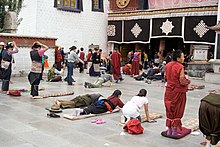
Most Tibetans generally observe Tibetan Buddhism or a drove of native traditions known as Bön (too absorbed into mainstream Tibetan Buddhism). At that place is a minority Tibetan Muslim population.[43] There is too a minor Tibetan Christian population in the eastern Tibet and northwestern Yunnan of Communist china. Likewise there are some Tibetan Hindus who mainly live in Red china, India and Nepal.
Co-ordinate to legend, the 28th male monarch of Tibet, Thothori Nyantsen, dreamed of a sacred treasure falling from sky, which contained a Buddhist sutra, mantras, and religious objects. Nevertheless, considering the Tibetan script had non been invented, the text could not be translated in writing and no 1 initially knew what was written in it. Buddhism did not accept root in Tibet until the reign of Songtsän Gampo, who married two Buddhist princesses, Bhrikuti of Nepal and Wencheng of China. It so gained popularity when Padmasambhāva visited Tibet at the invitation of the 38th Tibetan rex, Trisong Deutson.
Today, one can see Tibetans placing Mani stones prominently in public places. Tibetan lamas, both Buddhist and Bön, play a major role in the lives of the Tibetan people, conducting religious ceremonies and taking intendance of the monasteries. Pilgrims constitute prayer flags over sacred grounds as a symbol of skillful luck.
The prayer wheel is a ways of simulating the chant of a mantra by physically revolving the object several times in a clockwise direction. It is widely seen amidst Tibetan people. In order non to desecrate religious artifacts such as Stupas, mani stones, and Gompas, Tibetan Buddhists walk effectually them in a clockwise direction, although the reverse management is truthful for Bön. Tibetan Buddhists dirge the prayer "Om mani padme hum", while the practitioners of Bön chant "Om matri muye auction du".
Civilisation [edit]
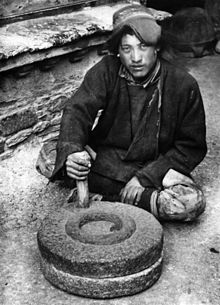
Tibetan wearing the typical hat operating a quern to grind fried barley. The perpendicular handle of such rotary handmills works as a crank (1938 photo).
Tibet is rich in culture. Tibetan festivals such as Losar, Shoton, Linka, and the Bathing Festival are securely rooted in indigenous religion and also incorporate foreign influences. Each person takes part in the Bathing Festival 3 times: at nascence, at marriage, and at decease.[ citation needed ]
Art [edit]
Tibetan art is securely religious in nature, from the exquisitely detailed statues found in Gonpas to wooden carvings and the intricate designs of the Thangka paintings. Tibetan art tin can exist found in almost every object and every aspect of daily life.
Thangka paintings, a syncretism of Indian scroll-painting with Nepalese and Kashmiri painting, appeared in Tibet around the 8th century. Rectangular and painted on cotton fiber or linen, they usually draw traditional motifs including religious, astrological, and theological subjects, and sometimes a mandala. To ensure that the image will not fade, organic and mineral pigments are added, and the painting is framed in colorful silk brocades.
Drama [edit]
Tibetan folk opera, known every bit lhamo, is a combination of dances, chants and songs. The repertoire is fatigued from Buddhist stories and Tibetan history.
Tibetan opera was founded in the fourteenth century by Thang Tong Gyalpo, a lama and a bridge-architect. Gyalpo and seven girls he recruited organized the first performance to raise funds for building bridges to facilitate transportation in Tibet. The tradition continued uninterrupted for nearly seven hundred years, and performances are held on various festive occasions such as the Lingka and Shoton festival. The performance is normally a drama, held on a arid phase that combines dances, chants, and songs. Colorful masks are sometimes worn to identify a character, with red symbolizing a rex and yellow indicating deities and lamas. The performance starts with a stage purification and blessings. A narrator and then sings a summary of the story, and the operation begins. Another ritual blessing is conducted at the stop of the play. There are also many historical myths/epics written by high lamas near the reincarnation of a "called one" who volition do cracking things.
Architecture [edit]
The most unusual feature of Tibetan architecture is that many of the houses and monasteries are congenital on elevated, sunny sites facing the south. They are commonly made of a mixture of rocks, forest, cement and earth. Little fuel is available for heating or lighting, so apartment roofs are built to conserve heat, and multiple windows are constructed to let in sunlight. Walls are commonly sloped inwards at ten degrees as a precaution confronting frequent earthquakes in the mountainous area. Tibetan homes and buildings are white-washed on the outside, and beautifully busy inside.
Standing at 117 metres (384 ft) in superlative and 360 metres (1,180 ft) in width, the Potala Palace is considered the most important example of Tibetan compages.[ citation needed ] Formerly the residence of the Dalai Lama, it contains over a thousand rooms within thirteen stories and houses portraits of the past Dalai Lamas and statues of the Buddha. Information technology is divided between the outer White Palace, which serves as the administrative quarters, and the inner Scarlet Quarters, which houses the assembly hall of the Lamas, chapels, ten,000 shrines, and a vast library of Buddhist scriptures.

Medicine [edit]
Traditional Tibetan medicine utilizes up to two thou types of plants, xl animal species, and fifty minerals. One of the primal figures in its development was the renowned eighth century dr. Yuthog Yontan Gonpo, who produced the Four Medical Tantras integrating textile from the medical traditions of Persia, Bharat and Prc. The tantras contained a full of 156 capacity in the form of Thangkas, which tell nearly the archaic Tibetan medicine and the essences of medicines in other places.[44]
Yutok Yonten Gonpo's descendant, Yuthok Sarma Yonten Gonpo, further consolidated the tradition past calculation eighteen medical works. One of his books[ specify ] includes paintings depicting the resetting of a broken bone. In addition, he compiled a fix of anatomical pictures of internal organs.[ citation needed ]
Cuisine [edit]

A elementary Tibetan breakfast
The Cuisine of Tibet reflects the rich heritage of the country and people's accommodation to loftier altitude and religious culinary restrictions. The most important ingather is barley. Dough made from barley flour, called tsampa, is the staple food of Tibet. This is either rolled into noodles or made into steamed dumplings called momos. Meat dishes are probable to be yak, goat or mutton, oft dried or cooked into a spicy stew with potatoes. Mustard seed is cultivated in Tibet and therefore features heavily in its cuisine. Yak yogurt, butter and cheese are frequently eaten and well-prepared yogurt is considered something of a prestige detail.[45] [ commendation needed ]
Clothing [edit]

Many Tibetans wear their hair long, although in contempo times due to Chinese influence,[ commendation needed ] virtually men do crop their hair brusk. The women braid their pilus into multiple tiny braids called "Rhe-Ba" or but simply put their hair upward in a braid or pony-tail in more rural areas. In more than urban areas, women wear many different kinds of hairstyles such equally pony-tails, braids, buns or simply leaving it down.
Some men and women clothing long thick dresses (chuba) in more traditional and rural regions. The men wear a shorter version with pants underneath. The manner of the clothing varies betwixt regions.[ commendation needed ] Nomads often clothing thick sheepskin versions. In more urban places like Lhasa, men and women dress in modern clothing, and many choose to clothing chuba during festivals and holidays like Losar.
Literature [edit]
Tibet has national literature that has both religious, semi-spiritual and secular elements. While the religious texts are well-known, Tibet is as well domicile to the semi-spiritual Gesar Epic, which is the longest ballsy in the world and is popular throughout Mongolia and Central Asia. At that place are secular texts such as The Dispute Between Tea and Chang (Tibetan beer) and Khache Phalu'southward Advice.
Marriage customs [edit]
Monogamy is common throughout Tibet. Marriages are sometimes arranged by the parents if the son or daughter has not picked their own partner by a sure age. However, polyandry is skillful in parts of Tibet. This is usually done to avoid partitioning of property and provide financial security.[46]
List of Tibetan states [edit]
- Zhangzhung Kingdom (500 BC–625)
- Yarlung Dynasty (?–618) (semi-mythological)
- Tibetan Empire (618–842)
- Kingdom of Bumthang (7th century–17th century)
- Guge Kingdom (842–1630)
- Purang Kingdom
- Maryul (930-1500)
- Tsongkha Kingdom (997–1099) (Amdo)
- Phagmodrupa Dynasty (1354–1618) (Ü-Tsang)
- Rinpungpa Dynasty (1435–1565) (Tsang)
- Tsangpa Dynasty (1565–1642) (Tsang)
- Ganden Phodrang (1642–1959)
- Namgyal Dynasty (1460–1842) (Ladakh)
- Chogyal Namgyal dynasty of Sikkim (1642–1975)
- Tibet (1912–51)
Kingdoms of Kham [edit]
- Nyagrong Kingdom (?–1865)
- Kingdom of Powo (?–1928)
- Nangcheng Kingdom (?–1928)
- Litang Kingdom (?–1950)
- Kingdom of Lingtsang (twelfth century–1950)
- Kingdom of Derge (15th century–1956)
- Hor States (Horpa)
- Chiefdom of Bathang
Gyalrong Kingdoms [edit]
- Kingdom of Chakla (1407–1950)
- Chiefdom of Chuchen
- Chiefdom of Tsanlha
See likewise [edit]
- History of Tibet
- Timeline of Tibetan history
- Flag of Tibet
- Sumpa
- Upper Mustang
- Sherpa people
- Baima people
- Balti people
- Bhotias and Bhutia
- Burig
- Lepcha people
- Limbu people
- Lhoba people
- Monpa Tibetan
- Thakali people
- Changpa people
- Golok people
- Wutun people
- Tibetan Muslims
- Tibetan diaspora
- Tibetan Americans
- Fundamental Tibetan Administration
- Tibetan independence movement
- Anti-Tibetan Sentiment
References [edit]
Citations [edit]
- ^ 藏族是汉语的称谓……统称为"博巴". Authorities of the People's Commonwealth of China. 18 March 2015.
- ^ "alphabetize". www.stats.gov.cn . Retrieved 6 May 2019.
- ^ Mukherjee, Kunal (28 Feb 2021). Race, Ethnicity and Religion in Disharmonize Across Asia. ISBN9781000371611.
- ^ a b "Tibetan – Becoming Minnesotan". Pedagogy.mnhs.org. Archived from the original on 20 Baronial 2013. Retrieved 15 August 2013.
- ^ "Language (Bharat, States and Union Territories)" (PDF). Demography of India 2011. Role of the Registrar Genera, India. 2018. p. 48.
- ^ Refugees, United nations High Commissioner for. "Refworld – Nepal: Data on Tibetans in Nepal". Refworld.org. Archived from the original on twenty October 2013. Retrieved 15 August 2013.
- ^ "Tibetan Immigrants in the United States: Extended Version". tenzinyeshi.com. Archived from the original on 24 October 2018. Retrieved 4 January 2019.
- ^ "Demography Profile, 2016 Census Archived 22 Apr 2018 at the Wayback Motorcar". Canada 2016 Demography. 2016.
- ^ "Tibet PM Cheers Swiss for fifty years of Refugee Shelter". 21 February 2011.
- ^ "Australian Tibetans Vote in Landmark Ballot For Tibet'southward New Leader". Atc.org.au. Archived from the original on 12 Apr 2013. Retrieved 14 Feb 2013.
- ^ a b Ghoso, Seonaigh MacPherson, Anne-Sophie Bentz, Dawa Bhuti (ii September 2008). "Global Nomads: The Emergence of the Tibetan Diaspora (Role I)". migrationpolicy.org. Archived from the original on 21 September 2018. Retrieved iv January 2019.
- ^ Origins and Migrations in the Extended Eastern Himalayas. BRILL, 2012, page 309.
- ^ "Red china bug white paper on history, evolution of Xinjiang (Role One)". Xinhua. 26 May 2003. Archived from the original on 9 June 2012. Retrieved 31 July 2010.
- ^ "People's republic of china STATISTICAL YEARBOOK" (PDF). Stats.gov.cn. 2003. Archived (PDF) from the original on vii March 2011. Retrieved 17 Baronial 2018.
- ^ Lewis, M. Paul (ed.), 2009. Ethnologue: Languages of the World, Sixteenth edition. Dallas, Tex.: SIL International. Online version on ethnologue.com Archived 27 December 2007 at the Wayback Machine
- ^ "United states senators corroborate 5,000 visas for Tibet refugees Archived 27 December 2013 at the Wayback Machine". The Straits Times. 21 May 2013.
- ^ Anna Akasoy; Charles S. F. Burnett; Ronit Yoeli-Tlalim (2011). Islam and Tibet: Interactions Along the Musk Routes. Ashgate Publishing, Ltd. pp. 358–. ISBN978-0-7546-6956-2.
- ^ "Population transfer and control". Wikiwix.com. Archived from the original on 22 August 2009. Retrieved 21 June 2012.
- ^ 1950–1990 年 (in Chinese (Red china)). Archived from the original on 24 November 2007.
- ^ Fischer, Andrew K. (2008). "Has there been a decrease in the number of Tibetans since the peaceful liberation of Tibet in 1951?" In: Authenticating Tibet: Answers to Mainland china'southward 100 Questions, pp. 134, 136. Edited: Anne-Marie Blondeau and Katia Buffetrille. University of California Press. ISBN 978-0-520-24464-1 (cloth); 978-0-520-24928-8 (pbk).
- ^ "Bloodshed rate, infant (per 1,000 live births)". Globe Bank. Archived from the original on xiii July 2010.
- ^ "Life expectancy in Tibet near doubled over last half-dozen decades: white paper". Xinhua. xi July 2011. Archived from the original on 15 November 2013.
- ^ 国家统计局-中国2010年人口普查资料
- ^ "127935 Tibetans living outside Tibet: Tibetan survey". Press Trust of India. 12 April 2010. Archived from the original on 27 September 2011. Retrieved 17 December 2010.
- ^ Edward J. Mills et al., Prevalence of mental disorders and torture among Tibetan refugees: A systematic review, BMC Int Health Hum Rights. 2005; five: seven. "Information technology is estimated that more than 150,000 Tibetan refugees reside in the neighboring countries of Bhutan, Nepal, and Republic of india"
- ^ a b c Lu, Dongsheng; et al. (1 September 2016). "Ancestral Origins and Genetic History of Tibetan Highlanders". The American Journal of Homo Genetics. 99 (3): 580–594. doi:ten.1016/j.ajhg.2016.07.002. PMC5011065. PMID 27569548.
- ^ Yang, Jian; Jin, Zi-Bing; Chen, Jie; Huang, Xiu-Feng; Li, Xiao-Homo; Liang, Yuan-Bo; Mao, Jian-Yang; Chen, Xin; Zheng, Zhili; Bakshi, Andrew; Zheng, Dong-Dong (18 Apr 2017). "Genetic signatures of loftier-altitude adaptation in Tibetans". Proceedings of the National Academy of Sciences. 114 (16): 4189–4194. doi:10.1073/pnas.1617042114. ISSN 0027-8424. PMC5402460. PMID 28373541.
- ^ "Tibetans adjusted to high altitude in less than 3,000 years". 30 Nov 2001.
- ^ "5 Myths About Mountain Everest". The Washington Post. 24 Apr 2014. Retrieved eighteen May 2019.
cites https://news.berkeley.edu/2010/07/01/tibetan_genome/ Tibetans adapted to loftier distance in less than 3,000 years
- ^ Simonson, Tatum Southward.; Yang, Yingzhong; Huff, Republic of chad D.; Yun, Haixia; Qin, Ga; Witherspoon, David J.; Bai, Zhenzhong; Lorenzo, Felipe R.; Xing, Jinchuan; Jorde, Lynn B.; Prchal, Josef T.; Ge, RiLi (2 July 2010), "Genetic Evidence for Loftier-Altitude Adaptation in Tibet", Science Mag, 329 (5987): 72–75, Bibcode:2010Sci...329...72S, doi:10.1126/science.1189406, PMID 20466884, S2CID 45471238
- ^ O'Luanaigh, Cian (two July 2010), "Mutation in key gene allows Tibetans to thrive at high altitude", The Guardian, archived from the original on half-dozen April 2017, retrieved xvi Dec 2016
- ^ S, Robert; ers; relations|, Media (1 July 2010). "Tibetans adapted to loftier altitude in less than 3,000 years". Berkeley News . Retrieved 11 April 2022.
- ^ Bhandari, Sushil; et al. (2015). "Genetic evidence of a recent Tibetan ancestry to Sherpas in the Himalayan region". Scientific Reports. five: 16249. Bibcode:2015NatSR...516249B. doi:10.1038/srep16249. PMC4633682. PMID 26538459.
- ^ a b Cole, Amy G.; Cox, Sean; Jeong, Choongwon; Petousi, Nayia; Aryal, Dhana R.; Droma, Yunden; Hanaoka, Masayuki; Ota, Masao; Kobayashi, Nobumitsu; Gasparini, Paolo; Montgomery, Hugh; Robbins, Peter; Di Rienzo, Anna; Cavalleri, Gianpiero L. (2017). "Genetic structure in the Sherpa and neighboring Nepalese populations". BMC Genomics. 18 (1): 102. doi:10.1186/s12864-016-3469-5. ISSN 1471-2164. PMC5248489. PMID 28103797.
 This article contains quotations from this source, which is available under the Creative Commons Attribution iv.0 International (CC BY 4.0) license.
 - ^ "Special Blood allows Tibetans to live the loftier life." New Scientist. 3 November 2007, p. 19.
- ^ "Elevated nitric oxide in claret is key to high altitude function for Tibetans". Eurekalert.org. Archived from the original on 3 November 2007.
- ^ "Tibetans Go Their Blood Flowing". Sciencenow.sciencemag.org. xxx October 2014. Archived from the original on 31 Oct 2007.
- ^ Hoit, Brian D.; Dalton, Nancy D.; Erzurum, Serpil C.; Laskowski, Daniel; Strohl, Kingman P.; Beall, Cynthia Thou. (2005). "Nitric oxide and cardiopulmonary hemodynamics in Tibetan highlanders". Journal of Applied Physiology. 99 (five): 1796–1801. doi:10.1152/japplphysiol.00205.2005. PMID 16024527.
- ^ "Tibetans inherited high-altitude cistron from ancient human being". Sciencemag.org. 2 July 2014. Archived from the original on 17 August 2018. Retrieved 17 August 2018.
- ^ Lu, Dongsheng; Lou, Haiyi; Yuan, Kai; Wang, Xiaoji; Wang, Yuchen; Zhang, Chao; Lu, Yan; Yang, Xiong; Deng, Lian; Zhou, Ying; Feng, Qidi (1 September 2016). "Bequeathed Origins and Genetic History of Tibetan Highlanders". The American Journal of Human Genetics. 99 (3): 580–594. doi:ten.1016/j.ajhg.2016.07.002. ISSN 0002-9297. PMC5011065. PMID 27569548.
- ^ He, Guanglin; Wang, Zheng; Su, Yongdong; Zou, Xing; Wang, Mengge; Chen, Xu; Gao, Bo; Liu, Jing; Wang, Shouyu; Hou, Yiping (23 May 2019). "Genetic structure and forensic characteristics of Tibeto-Burman-speaking Ü-Tsang and Kham Tibetan Highlanders revealed by 27 Y-chromosomal STRs". Scientific Reports. nine (ane): 7739. Bibcode:2019NatSR...9.7739H. doi:10.1038/s41598-019-44230-2. ISSN 2045-2322. PMC6533295. PMID 31123281.
- ^ Stein, R.A. (1972). Tibetan Civilization. J.Eastward. Stapleton Driver (trans.). Stanford University Printing. pp. 28, 46.
- ^ 卡力岗现象及其分析—— 中文伊斯兰学术城. Islambook.net (in Simplified Chinese). Archived from the original on 12 March 2012. Retrieved 21 June 2012.
- ^ "Thangka- Buddhist Fine art".
- ^ "Shoton Festival – The Yogurt Celebration of Tibet". Explore Tibet. 16 August 2018. Retrieved xx February 2019.
- ^ Stein (1978), pp. 97–98.
Sources [edit]
- Chisholm, Hugh, ed. (1911). . Encyclopædia Britannica. Vol. 26 (11th ed.). Cambridge University Press. p. 918.
- Goldstein, Melvyn C., "Study of the Family unit structure in Tibet", Natural History, March 1987: 109–112. ([ane] on the Internet Archive).
- Stein, R.A. (1972). Tibetan Civilization. J.Due east. Stapleton Driver (trans.). Stanford Academy Press. ISBN 0-8047-0901-seven (paper); ISBN 0-8047-0806-1.
- Su, Bing, et al. "Y chromosome haplotypes reveal prehistorical migrations to the Himalayas". Homo Genetics 107, 2000: 582–590.
External links [edit]
- Imaging Everest: article on Tibetan people at the time of early mountaineering from the Royal Geographical Society
- Tibetan costume from red china.org.cn
- Rukor where the world discusses the fate of the nomads
- Map share of ethnic past county of China
Source: https://en.wikipedia.org/wiki/Tibetan_people

Post a Comment for "From Where Did Sherpas Ancestors Come? What Has Influenced Much of South Asias Arts?"